My CHC2P1 class last year was very easy going and completed daily work and assignments with little resistance. I think this allowed me to become rather complacent in my teaching. I relied heavily on the textbook because it was easy for me and the students did their work. I know that there is better pedagogy and I have designed the first unit to force my students to take responsibility for their learning.
I have decided that we are going to create a class website about Canada's identity during World War One and the 1920s. You can check out the purpose of the task and the responsibilities assigned to the students in this Google Doc.
Students will learn the content required through the creation of the website. Instead of relying heavily on the textbook, videos, and "sage on the stage", students will be afforded the opportunity to discover the information themselves. Additionally, they will be able to focus on an area that interests them, which makes learning more meaningful. Furthermore, students will work on important skills, such as research, collaboration, communication, problem-solving and organization.
Students won't be abandoned to create the website themselves. We will brainstorm ideas, work on reading primary sources, and analyze images together. There will be regular, and hopefully meaningful and helpful, one-to-one conversations as students create their web pages.
The website is the method of learning the material. Students will not be evaluated formally on their web pages. The department summative task for this unit is the analysis of primary sources, so this will be completed after the website goes live. Students will use the information they learned, through their research and reading their classmates' web pages, to complete the summative task.
I have high hopes that creating this website will work. Stay tuned for my reflections when we get into the dirty work.
Sunday, 11 August 2013

Thursday, 25 July 2013
Would getting rid of grades make for happier students?
On Monday night, Dean Shareski (@shareski), who everyone on Twitter should follow, tweeted the statement below. I have thought a lot about his tweet, especially because I retweeted it immediately upon reading it, then I began to question it.

When I first read the tweet, my gut reaction was "Of course, being happy is incredibly important, more important than often meaningless letter grades." But then I began to think about the ramifications of failing every class in high school (the context I'm familiar with). If a student doesn't earn a high school diploma, opportunities in life become rather limited. I can't help but think that the happiness experienced while failing school will be short lived.
Gord Holden's response to the tweet (above) helps put into context what I believe in my heart. I agree with him that education is "learning how to achieve satisfaction in life". But Shareski's response that "folks...focused on things they can easily measure" brings to light the struggle in education. How on earth can you measure "achieving satisfaction in life"? It is much easier to give the students a literacy test to determine if they are literate.
I think the problem--and why I might prefer students to fail and be happy, rather than be miserable from the stress of earning A's--is that we celebrate the students who get the A's, even if they really haven't learned anything. Students who are failing might actually be learning more than the students who are getting A's. I've only been a teacher for a short time, but I am finding it irritating that the criteria for winning the subject awards at my school is simply to have the highest grade. Most students are focused on getting good grades and not on actual learning. When we celebrate mostly students with top marks, we send the message that what we value most are A's, not learning and not happiness.
There is most certainly a shift towards fostering learning for learning's sake, but the stumbling block of determining grades is still predominantly present. I wonder if we got rid of grades if we would have happier students who are learning more and who will see greater success.
Monday, 15 July 2013
The Hardest Class I Ever Taught
CHC2D1--Semester 2, 2013
Three weeks after finishing teaching this class, I am confident in saying that it was the hardest class I ever taught. I honestly thought the hardest class I ever taught was a credit recovery class mixed with students who had been removed from their classes because of disruptive behaviour and students on in-school suspension. In this class, I dealt with a student who pulled out a beer in the middle of class or another student who was so high and shouting a string of curse words that I didn't even know existed! I dealt with uncountable discussions of rolling blunts and fights on Saturday nights.
Dealing with those issues seem a breeze when trying to engage the disengaged. I understand that many people think Canadian history is boring...but I am trying to make it engaging and interesting.
The first couple of weeks were rough because the class was so quiet. The quiet was uncomfortable. It wasn't just quiet when I attempted discussion, the classroom was quiet even when working in small groups or when classrooms shouldn't be quiet...when the teacher is trying to get the technology to work or in the last five minutes of class when waiting for the lunch bell. I realize now that the quiet was probably the result of boring discussion questions and boring tasks.
Another history teacher, Erin (@erinharrison20) and I discussed our issues, because, while her class was the opposite of quiet, both of us had difficulty with engagement. Erin came up with a great inquiry-based task for the unit looking at the creation of model society via Diefenbaker, Pearson, Trudeau and Quebec. Students were in groups to research one of the topics with the question "What is the ideal society for Canada?" Students needed to create a way to share their learning with the other groups. The culmination of this inquiry was the creation of a podcast, which was my favourite assignment. It was developed by Lisa Unger (@l_unger) and James Bryson.
Things weren't perfect. Students weren't used to taking control of their learning or being responsible for teaching each other and learning from one another. I think this can be remedied by using an inquiry-based approach throughout the entire course. My goal for next year is to look at each of the summative assignments and figure out how to create inquiry-tasks so that students have control over how they're learning the material and developing their skills. It is also important to note that I have to let go and accept that students don't need to learn EVERYTHING about Canada from 1914-present. First off, that's not possible and secondly, that's not important. It is more important that students have control over uncovering content and concepts that connect to the big idea that "Canada's identity is revealed by its past". Nowhere in this big idea does it say that students must learn about victory bonds or the dust bowl or NATO.
Now the hard work begins...how can I create engaging inquiry questions so the students want to learn about Canadian history?
Three weeks after finishing teaching this class, I am confident in saying that it was the hardest class I ever taught. I honestly thought the hardest class I ever taught was a credit recovery class mixed with students who had been removed from their classes because of disruptive behaviour and students on in-school suspension. In this class, I dealt with a student who pulled out a beer in the middle of class or another student who was so high and shouting a string of curse words that I didn't even know existed! I dealt with uncountable discussions of rolling blunts and fights on Saturday nights.
 |
| Nothing quite like a student having a leftover beer in her backpack. |
Dealing with those issues seem a breeze when trying to engage the disengaged. I understand that many people think Canadian history is boring...but I am trying to make it engaging and interesting.
The first couple of weeks were rough because the class was so quiet. The quiet was uncomfortable. It wasn't just quiet when I attempted discussion, the classroom was quiet even when working in small groups or when classrooms shouldn't be quiet...when the teacher is trying to get the technology to work or in the last five minutes of class when waiting for the lunch bell. I realize now that the quiet was probably the result of boring discussion questions and boring tasks.
Another history teacher, Erin (@erinharrison20) and I discussed our issues, because, while her class was the opposite of quiet, both of us had difficulty with engagement. Erin came up with a great inquiry-based task for the unit looking at the creation of model society via Diefenbaker, Pearson, Trudeau and Quebec. Students were in groups to research one of the topics with the question "What is the ideal society for Canada?" Students needed to create a way to share their learning with the other groups. The culmination of this inquiry was the creation of a podcast, which was my favourite assignment. It was developed by Lisa Unger (@l_unger) and James Bryson.
Now the hard work begins...how can I create engaging inquiry questions so the students want to learn about Canadian history?
Sunday, 30 June 2013
Practice makes perfect...but I don't want to be perfect, I just want to improve
I think most (all?) teachers have favourite courses to teach. I love teaching ENG3U1. Next year I am excited because I get to teach the class both semesters. It is also unusual in that there will only be three teachers doing the course, not a minimum of five different teachers, as has happened in the past. I think this will be easier to create a tighter course through collaboration.
In case I forget everything over the summer months, I want to reflect on what I did this past semester and how I will improve it for next year.
Getting Off on the Right Foot: Close Reading
I think the way I started the course this past semester is fine...but I want to do it better next year. We discussed the inappropriate use of cultural costumes and used on-topic articles to practice writing analytical paragraphs. We then transitioned into reading The Rez Sisters. For next year, I am going to start right away with a unit on close reading. Close reading is the key to being able to make meaning of a text, so I think I need to start with the skills required to do so. I am going use a variety of texts, such as poetry, photographs, documentaries and articles. We will use strategies, including TPLASTT, SOAPSTone and Says/Does Analysis, to uncover meaning. The summative task for this unit will be an in-class close reading response essay.
Novel Study: The Kite Runner
After a short unit on close reading, we will transition to our novel study, which is The Kite Runner. Based on my own reflections and student feedback, we didn't spend enough time on the novel. I felt very rushed, because I spent so much time on Macbeth. In previous years, we spent time on getting a thorough understanding of Afghanistan and its culture. We also focused on cultural identifiers, which are key for the ISU. I think this is necessary and I will be incorporating these aspects into the tutorials that the students will lead. There are a series of skills, beyond close reading, that students will have the opportunity to hone. In this unit, we will work on presenting, questioning, and leading and participating in class discussions, both face-to-face and on-line. Again the summative task for this unit will be an in-class close reading response essay.
- Presentation: In the first chapter of The Kite Runner, Amir alludes to his defining moment. I really enjoyed the presentations my students did on their defining moments, so I will do this again. This time I will incorporate some formative assessment Scott Jordan shared with me. I will use the "Stars and Wishes" technique. After a student presents, classmates will share what they thought was well done in the presentation (Stars) and what needs to be improved upon (Wishes). Additionally, I will videotape the presentations so that students can actually see how they present. I will go first. I know that presenting is a great fear of students, and mine too, so I will share my vulnerabilities with the students.
- Tutorials: This past year, my students did literature circles. I have used literature circles in the past, but this year, it was a failure. I think they failed because marks were not attached to them, so students didn't see their value. Additionally, I think students were overwhelmed because they were also reading their ISU novel. The purpose of the tutorials is to share appropriate background information applicable to the assigned chapters, ask questions that demonstrate understanding of the text and spark conversation and present in front of an audience. This "Q Chart" adapted by Lisa Unger will be helpful for the students when they are creating their questions.
- Blogging: Once the tutorials are under way, I will introduce blogging. I have blogged about blogging here and here. I wasn't happy with the rubric I used to assess the students' blogs, so I have to revamp it this summer.
The Independent Study--Cultural Novels
This past semester, we departed from the usual ENG3U1 ISU. In first semester, a colleague had the students focus on using secondary texts to support the definitive statement the students pulled from their primary text. This was developed in an essay. For second semester, I also used this idea and reworked it so that the students did a presentation on their novel. I found the presentations tedious, but I take responsibility for that because I did not give the students enough practice presenting. I hope to remedy that by doing informal presentations, with feedback, throughout the semester. I am going to keep the ISU presentation, because I believe that the ability to present well is an incredibly important skill.
Originally, I liked the idea of using secondary texts to support the definitive statement about culture, because it supports one of the big ideas of the course. I have come to realize that I do not like that big idea, and as such, I am not going to focus the ISU on it. I explain my concerns here. The students will still focus on reading a novel about another culture, but they will focus on the perspective the author puts forth, using evidence solely from that novel. I found that the presentations were rather superficial and the students could easily get away with not thoroughly reading their primary novel, nor thoroughly analyse secondary texts.
The ISU will be worked on concurrently with the final two units, The Rez Sisters and Macbeth. The actual ISU presentations will take place over the last couple of days of the semester.
Play Study: The Rez Sisters
I was first introduced to Tomson Highway's play, The Rez Sisters, in university and I quickly fell in love with it. It is an "easy" read, but there are many complexities to be explored within the play. It brings to light the many issues faced by Native Canadians living on the reserve. Highway makes great use of symbolism to expand on these issues. There isn't a lot I am going to change with this unit, except the summative assessment. The students will still write an analytical paragraph, but the question I used this semester focused on analyzing the perspective of one of the sisters. I was trying to connect to one of the big ideas. I found the question to be lame and for the next semester, the question is going to focus on analyzing one of the many symbols in the play, such as the toilet, the can of condensed milk or the 18 wheeler.
I still believe Shakespeare is relevant!
 |
| Captioned by Aiden, Branson, Cody and Marjone |
Our final unit of study will be Macbeth, one of my favourite Shakespearean plays. As I previously mentioned, this unit really dragged on last semester. I don't think it was because I actually spent more time on it. The unit was interrupted by March Break, Easter holidays and numerous no bus days, including two that were back-to-back. With this unit, I am not going to change much. I will definitely have the students tweet Macbeth. I detail the experience here. Depending on time, I will repeat the activity of the students putting Macbeth and Lady Macbeth on trial and The Great Meme Challenge. The summative task will be an in-class passage analysis, just like this past semester.
The Final Exam
In previous semesters, the culminating 30% was made up of the ISU essay and small group tutorials. This past semester, we made the change to a written exam worth 30% of the grade. Students read a series of texts with about hip hop and used evidence to write an analytical paragraph answering the question: What is hip hop? I was satisfied with this exam, but because I am making a shift in the ISU, students will not have the practice of synthesizing texts, so I don't think this type of exam will work for next year. In speaking with ENG2D1 and ENG4U1 teachers, I think the exam for next year will be a close reading response essay. This is reflective of the analytical and communication skills the students worked on over the course of the semester.
Obviously, this course of action is not set in stone and I am willing to make changes to the course.
Thursday, 20 June 2013
Thinking about Big Ideas
Ever since my second year of teaching, creating big ideas to drive student learning has been the focus of curriculum development at my school. Each course, in general, has one big idea that the students should understand inside and out by the end of the course.
Creating big ideas for courses is hard work. In grade 10 Canadian history, over the last four years, we have attempted three or four big ideas. This year our big idea is:
The Canadian identity is revealed through its past.
We have committed to sticking to this idea for two school years. There was concern that we weren't fully testing out an idea before deciding it didn't work. I don't think this big idea is particularly earth-shattering, but it works for the course because it allows flexibility for the teacher.
Part of me is starting to question the value of having one overarching big idea. To explain, the big idea for history is rather obvious, but it is working for our purposes. There is a built-in flexibility to it, but I wonder about its value if it is so flexible and open to interpretation. I think the reason this big idea appears to be working is because each unit has its own big idea and driving question. I told a colleague that I found Unit 3 to be more focused and I had a direction. She asked if it was because it was my fourth time teaching the course or because the big idea helped. I don't think it was any of those reasons. Unit three was clearer to me because I had a "mini" big idea: Canada's prime ministers worked to create a model society. I can't help but think "mini big ideas" are a more effective way to structure the course.
The "multiple mini big ideas" do pose a problem. How do we truly backward design a course if there isn't one overarching concept for the students to understand? What would the final culminating task look like? I think our department has found an acceptable solution in having a broad, if obvious, big idea, because our "mini big ideas" really provide the focus and the big idea ties them together.
In addition to history, I also teach English. All of our English classes have three big ideas in common:
The big idea for ENG1D1 sounds like a big idea for a learning strategies course. To be honest, when reading To Kill a Mockingbird or A Midsummer Night's Dream, I don't care if the students can identify the strategies Scout or Helena develop to overcome their issues. I am more interested in the "meatier" themes of the novels, such as the impact of discrimination or the value of women in Athens.
I find the current big idea "strangling" because I feel as though the focus of studying this great works of literature is on something so narrow that the true value of the texts is lost. I feel the same way about the big idea in ENG3U1. I don't want to assign a numerical grade to the students' ability to better understand the world around them. I want to expose them to varying viewpoints and help them see new perspectives, but I don't think I can evaluate their understanding in a meaningful way. In essence, I think the course-specific big ideas are interesting ideas to discuss, but I don't think it is necessary to connect every text studied to the big idea. I want the students to read a variety of texts for their value, not because they fit into a "strangling" framework.
Overall, I think big ideas can help focus a unit, but I wonder if an overarching big idea for an entire class ends up being so broad that it isn't really meaningful.
Creating big ideas for courses is hard work. In grade 10 Canadian history, over the last four years, we have attempted three or four big ideas. This year our big idea is:
The Canadian identity is revealed through its past.
We have committed to sticking to this idea for two school years. There was concern that we weren't fully testing out an idea before deciding it didn't work. I don't think this big idea is particularly earth-shattering, but it works for the course because it allows flexibility for the teacher.
 |
| Please don't tell me this is the Canadian identity!!! |
Part of me is starting to question the value of having one overarching big idea. To explain, the big idea for history is rather obvious, but it is working for our purposes. There is a built-in flexibility to it, but I wonder about its value if it is so flexible and open to interpretation. I think the reason this big idea appears to be working is because each unit has its own big idea and driving question. I told a colleague that I found Unit 3 to be more focused and I had a direction. She asked if it was because it was my fourth time teaching the course or because the big idea helped. I don't think it was any of those reasons. Unit three was clearer to me because I had a "mini" big idea: Canada's prime ministers worked to create a model society. I can't help but think "mini big ideas" are a more effective way to structure the course.
The "multiple mini big ideas" do pose a problem. How do we truly backward design a course if there isn't one overarching concept for the students to understand? What would the final culminating task look like? I think our department has found an acceptable solution in having a broad, if obvious, big idea, because our "mini big ideas" really provide the focus and the big idea ties them together.
In addition to history, I also teach English. All of our English classes have three big ideas in common:
1. Everything that contains meaning is a text, which can be understood using strategies.
This big idea is useful, because at the end of a course, students should have developed and practiced various strategies to understand the meaning of a text. Students learn a variety of ways to approach texts, such as TPCASTT, SOAPSTone and Says/Does Analysis.
2. Understanding texts leads to a better understanding of the self and the world.
The concept behind this big idea is valuable because it offers an explanation for why we read Shakespeare or analyze a poem. Reading texts develops an awareness to new people, places and ideas. That said, I can't help but feel that this big idea is rather "airy fairy". How can we assess whether or not a student now has a better sense of the self and the world? Do we want to assess if they better understand themselves and the world? I am not arguing that this isn't important, but I don't think this understanding can effectively be evaluated in a passage analysis or an analytical paragraph. First off, we would have to a base line. To what degree did students understand themselves and the world before reading a text? How can we track this change?
3. A person’s message is best understood by an audience when it is communicated in a clear and concise manner.
I love this big idea. I find it very freeing. We can study anything in English class, as long as the students are working on their communication skills. This big idea is cross-curricular and focuses on an important skill: the ability to effectively communicate. I am well aware that very few of my students are going to go on to study English, but ALL of them need to be able to effectively communicate.
In addition to the common big ideas, each course has its own big idea. I can only address the two courses I have taught recently. The big idea of ENG1D1 is: Everyone faces challenges in their life and develops strategies to try to overcome them. The big idea of ENG3U1 is: Considering multiple viewpoints allows people to better understand the world around them. A colleague describe these big ideas as "strangling" and I agree.
The big idea for ENG1D1 sounds like a big idea for a learning strategies course. To be honest, when reading To Kill a Mockingbird or A Midsummer Night's Dream, I don't care if the students can identify the strategies Scout or Helena develop to overcome their issues. I am more interested in the "meatier" themes of the novels, such as the impact of discrimination or the value of women in Athens.
 |
| The Quarrel of Oberon and Titania by Joseph Noel Paton |
Saturday, 15 June 2013
Awesomeness in a Variety of Ways
There has been a lot of debate about the use of technology in the classroom.
Some people argue that it takes away from the students' ability to demonstrate what they really know because they are focused on playing with the tool. Additionally, there is concern that the teacher will be wowed by all the bells and whistles and the students will be awarded a grade that doesn't truly reflect their knowledge and understanding.
Others argue that "old school" Bristol board assignments are just a bunch of pictures and papers glued onto sometimes colourful paper with a dash of glitter and stickers. Again the teacher may be swayed by all the pretty. There might not be any evidence of learning.
This is concerning because both argue that a teacher doesn't have the ability to fairly assess students' work. But I don't really want to get into this, I just want to assure you that students can demonstrate their learning in a variety of ways.
I just finished assessing my CHC2D1 culminating projects. Students used a variety of tools to complete the assessment that focused on the question: What has the past 100 years revealed about Canada's identity? Three of the assignments earned nearly perfect grades...and not because of the tool used. One student used Bristol board to create a poster, another used Prezi and still another created a slideshow rant using iMovie. All three assignments earned top grades because they carefully answered the question, using evidence from course and explaining how that evidence supported their answer.
As educators, we should be giving students a variety of ways to demonstrate their learning and not get caught up on which way is better, because there is no right answer. Students can select what method is going to work for their purposes. And if they are having trouble, it is up to the teacher to have a conversation with the student to help decide what is the best tool for the job.
In essence, don't throw away the markers and stickers, nor dismiss technology, it all has a place in our classrooms.
Some people argue that it takes away from the students' ability to demonstrate what they really know because they are focused on playing with the tool. Additionally, there is concern that the teacher will be wowed by all the bells and whistles and the students will be awarded a grade that doesn't truly reflect their knowledge and understanding.
Others argue that "old school" Bristol board assignments are just a bunch of pictures and papers glued onto sometimes colourful paper with a dash of glitter and stickers. Again the teacher may be swayed by all the pretty. There might not be any evidence of learning.
 |
| Evan-Amos--Wikimedia Commons |
This is concerning because both argue that a teacher doesn't have the ability to fairly assess students' work. But I don't really want to get into this, I just want to assure you that students can demonstrate their learning in a variety of ways.
I just finished assessing my CHC2D1 culminating projects. Students used a variety of tools to complete the assessment that focused on the question: What has the past 100 years revealed about Canada's identity? Three of the assignments earned nearly perfect grades...and not because of the tool used. One student used Bristol board to create a poster, another used Prezi and still another created a slideshow rant using iMovie. All three assignments earned top grades because they carefully answered the question, using evidence from course and explaining how that evidence supported their answer.
 |
| Baralpo--Creative Commons |
As educators, we should be giving students a variety of ways to demonstrate their learning and not get caught up on which way is better, because there is no right answer. Students can select what method is going to work for their purposes. And if they are having trouble, it is up to the teacher to have a conversation with the student to help decide what is the best tool for the job.
In essence, don't throw away the markers and stickers, nor dismiss technology, it all has a place in our classrooms.
Monday, 10 June 2013
Improving the Blogging Experience for Students
This past semester I encouraged my students to blog, as a way to make their thinking visible. Back in March, I posted my first reflections about the endeavour. Check them out here. As the semester winds down, I have been reflecting about blogging and how to improve it for next year. Below I detail the drawbacks I experienced and how I hope to address them.
Drawback #1: Lack of ownership
This year I set up one blog for each class and made each student an author. This is a collaborative or multi-author blog. Students didn't own their space. I fear that this lack of ownership didn't allow them to feel a connection to what they were doing. They were just contributing to something that the teacher created. Additionally, as a multi-author blog, only the blog owner (me) got notification emails when people responded. One of the best parts of blogging is having someone respond and the ensuing conversation, but the students never got that satisfaction. They would have to go back to their post to see if anyone responded.
Improvement #1: Independent Blogs
For next year, I will have each student open their own blog via UG Cloud. Students can then customize their blog, which I hope will create ownership. Furthermore, students will get notification when people respond to their blogs. I will set up an RSS feed so that students have an easy way to connect with their classmates' blogs.
Drawback #2: Rigidity
I set aside specific times to go to the library to blog. Upon reflection, this made blogging very forced and the students often thought that only had to blog when there was class time dedicated to it. I want students to blog when a topic strikes them and I want them to blog outside of specified times. From my own blogging, I find it hard to blog "on demand". I wanted the students to blog at least 10 times and respond to at least 20 posts. I focused too much on quantity, when what I really care about is quality. This made the task cumbersome and similar to a countdown. I heard myself telling students, "You only need to respond to three more posts." This wasn't authentic; blogging became just another assignment. I also had blogging prompts, but students thought that meant they had to write about one of the prompts. This took away from their ownership.
Improvement #2: Flexibility
I am slowly moving away from teacher-centred instruction. I have experimented around with student-directed activities, and I think that by regularly having students direct their learning they will have more flexibility to blog during class. Hopefully this will give them more ideas about what they can blog about. The blogs would also operate as a way to provide formative feedback. Next year I won't have a minimum number of blog posts to write or to respond. I feel as though the number creates too much pressure and quality suffers because of the need to get x-number of posts done. Additionally, right from the beginning, I will encourage students to create their own blogging ideas. Hopefully, this makes blogging more personal and relevant.
Drawback #3: Lack of Feedback and Conversation
One of my biggest concerns was the quality of the students' comments on their peers' blogs and the lack of conversation. Despite providing students with stems and conversation starters, comments were often of the "Nice post" quality. Students saw commenting as something they had to do and get over with. There wasn't much evidence of deep thinking. Furthermore, I modeled effective commenting for them. I gave students feedback on their feedback. I need to do more than that.
Improvement #3: Practice Face-to-Face and Model
Before I have students blog, I am going to have them practice giving each other feedback and having a conversation face-to-face. In class, we will have discussions and dissect why the conversation was able to continue or why it stalled. Additionally, I will dedicate some time to specifically responding to each others' blogs. Students will not focus on creating their own posts. Their focus will be on responding to each other and carrying on an online conversation.
Alanna King (@banana29) tweeted out a blog post by Kathleen Morris, an educator in Australia. The image below, from Kathleen's blog, really spoke to me and will help me to frame blogging with my classes.
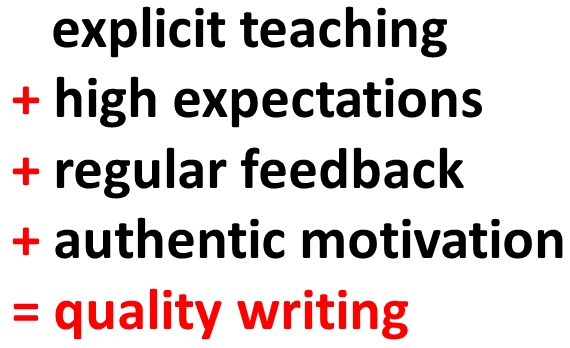
 For some reason, I didn't think that it was necessary to explicitly teach the mechanics of blogging. I discussed WHY we were blogging, but I never went into the details of HOW to blog. Next year I will take time to discuss feedback and continuing conversations. Additionally, as previously mentioned, I had a specific number of posts and responses I wanted the students to complete. These expectations aren't high enough, nor do they reflect what I really want the students to get out of blogging, which is deep thinking about their learning. By providing regular feedback, students will be reminded of the high expectations they are to be meeting. Authentic motivation is so important, but I think can be difficult, especially when students aren't interested in the topic. Unfortunately, some topics can't be helped...they are part of the curriculum. I see it as my job to try and make topics relevant and help students to make a personal connection.
Additionally, I will share this blog post, by Doug Peterson (@dougpete), which details tips for successful blogging. One of the points that stood out was the fact that blogging takes courage. I will share with my students how difficult I, as a teacher, find it to post my thoughts. As I was writing this post, I hesitated if I would even publish it. I also liked the point about being positive. When I started this post, I wondered if I was being negative, but then I thought some more about the purpose. My purpose was to explore the drawbacks I encountered and find ways to improve blogging. Ultimately, I don't think I am complaining; rather, I like to think that I am being constructive.
I have quite a lot of work ahead of me to make blogging work for my classes and I am always looking for ways to improve the experience. I truly believe that blogging can be powerful for students and teachers alike and I am not willing to give up.
Drawback #1: Lack of ownership
This year I set up one blog for each class and made each student an author. This is a collaborative or multi-author blog. Students didn't own their space. I fear that this lack of ownership didn't allow them to feel a connection to what they were doing. They were just contributing to something that the teacher created. Additionally, as a multi-author blog, only the blog owner (me) got notification emails when people responded. One of the best parts of blogging is having someone respond and the ensuing conversation, but the students never got that satisfaction. They would have to go back to their post to see if anyone responded.
Improvement #1: Independent Blogs
For next year, I will have each student open their own blog via UG Cloud. Students can then customize their blog, which I hope will create ownership. Furthermore, students will get notification when people respond to their blogs. I will set up an RSS feed so that students have an easy way to connect with their classmates' blogs.
Drawback #2: Rigidity
I set aside specific times to go to the library to blog. Upon reflection, this made blogging very forced and the students often thought that only had to blog when there was class time dedicated to it. I want students to blog when a topic strikes them and I want them to blog outside of specified times. From my own blogging, I find it hard to blog "on demand". I wanted the students to blog at least 10 times and respond to at least 20 posts. I focused too much on quantity, when what I really care about is quality. This made the task cumbersome and similar to a countdown. I heard myself telling students, "You only need to respond to three more posts." This wasn't authentic; blogging became just another assignment. I also had blogging prompts, but students thought that meant they had to write about one of the prompts. This took away from their ownership.
Improvement #2: Flexibility
I am slowly moving away from teacher-centred instruction. I have experimented around with student-directed activities, and I think that by regularly having students direct their learning they will have more flexibility to blog during class. Hopefully this will give them more ideas about what they can blog about. The blogs would also operate as a way to provide formative feedback. Next year I won't have a minimum number of blog posts to write or to respond. I feel as though the number creates too much pressure and quality suffers because of the need to get x-number of posts done. Additionally, right from the beginning, I will encourage students to create their own blogging ideas. Hopefully, this makes blogging more personal and relevant.
Drawback #3: Lack of Feedback and Conversation
One of my biggest concerns was the quality of the students' comments on their peers' blogs and the lack of conversation. Despite providing students with stems and conversation starters, comments were often of the "Nice post" quality. Students saw commenting as something they had to do and get over with. There wasn't much evidence of deep thinking. Furthermore, I modeled effective commenting for them. I gave students feedback on their feedback. I need to do more than that.
Improvement #3: Practice Face-to-Face and Model
Before I have students blog, I am going to have them practice giving each other feedback and having a conversation face-to-face. In class, we will have discussions and dissect why the conversation was able to continue or why it stalled. Additionally, I will dedicate some time to specifically responding to each others' blogs. Students will not focus on creating their own posts. Their focus will be on responding to each other and carrying on an online conversation.
Alanna King (@banana29) tweeted out a blog post by Kathleen Morris, an educator in Australia. The image below, from Kathleen's blog, really spoke to me and will help me to frame blogging with my classes.
Additionally, I will share this blog post, by Doug Peterson (@dougpete), which details tips for successful blogging. One of the points that stood out was the fact that blogging takes courage. I will share with my students how difficult I, as a teacher, find it to post my thoughts. As I was writing this post, I hesitated if I would even publish it. I also liked the point about being positive. When I started this post, I wondered if I was being negative, but then I thought some more about the purpose. My purpose was to explore the drawbacks I encountered and find ways to improve blogging. Ultimately, I don't think I am complaining; rather, I like to think that I am being constructive.
I have quite a lot of work ahead of me to make blogging work for my classes and I am always looking for ways to improve the experience. I truly believe that blogging can be powerful for students and teachers alike and I am not willing to give up.
Subscribe to:
Posts (Atom)