Monday, 10 June 2013

Improving the Blogging Experience for Students

This past semester I encouraged my students to blog, as a way to make their thinking visible.  Back in March, I posted my first reflections about the endeavour.  Check them out here.  As the semester winds down, I have been reflecting about blogging and how to improve it for next year.  Below I detail the drawbacks I experienced and how I hope to address them.

Drawback #1: Lack of ownership
This year I set up one blog for each class and made each student an author.  This is a collaborative or multi-author blog.  Students didn't own their space.  I fear that this lack of ownership didn't allow them to feel a connection to what they were doing.  They were just contributing to something that the teacher created.  Additionally, as a multi-author blog, only the blog owner (me) got notification emails when people responded.  One of the best parts of blogging is having someone respond and the ensuing conversation, but the students never got that satisfaction.  They would have to go back to their post to see if anyone responded.
Improvement #1: Independent Blogs
For next year, I will have each student open their own blog via UG Cloud.  Students can then customize their  blog, which I hope will create ownership.  Furthermore, students will get notification when people respond to their blogs.  I will set up an RSS feed so that students have an easy way to connect with their classmates' blogs.

Drawback #2: Rigidity 
I set aside specific times to go to the library to blog.  Upon reflection, this made blogging very forced and the students often thought that only had to blog when there was class time dedicated to it.  I want students to blog when a topic strikes them and I want them to blog outside of specified times.  From my own blogging, I find it hard to blog "on demand".  I wanted the students to blog at least 10 times and respond to at least 20 posts.  I focused too much on quantity, when what I really care about is quality.  This made the task cumbersome and similar to a countdown.  I heard myself telling students, "You only need to respond to three more posts."  This wasn't authentic; blogging became just another assignment.  I also had blogging prompts, but students thought that meant they had to write about one of the prompts.  This took away from their ownership.
Improvement #2: Flexibility
I am slowly moving away from teacher-centred instruction.  I have experimented around with student-directed activities, and I think that by regularly having students direct their learning they will have more flexibility to blog during class. Hopefully this will give them more ideas about what they can blog about.  The blogs would also operate as a way to provide formative feedback. Next year I won't have a minimum number of blog posts to write or to respond.  I feel as though the number creates too much pressure and quality suffers because of the need to get x-number of posts done.  Additionally, right from the beginning, I will encourage students to create their own blogging ideas.  Hopefully, this makes blogging more personal and relevant.

Drawback #3: Lack of Feedback and Conversation
One of my biggest concerns was the quality of the students' comments on their peers' blogs and the lack of conversation.  Despite providing students with stems and conversation starters, comments were often of the "Nice post" quality.  Students saw commenting as something they had to do and get over with. There wasn't much evidence of deep thinking.  Furthermore, I modeled effective commenting for them.  I gave students feedback on their feedback.  I need to do more than that.
Improvement #3: Practice Face-to-Face and Model
Before I have students blog, I am going to have them practice giving each other feedback and having a conversation face-to-face.  In class, we will have discussions and dissect why the conversation was able to continue or why it stalled.  Additionally, I will dedicate some time to specifically responding to each others' blogs.  Students will not focus on creating their own posts.  Their focus will be on responding to each other and carrying on an online conversation.

Alanna King (@banana29) tweeted out a blog post by Kathleen Morris, an educator in Australia.  The image below, from Kathleen's blog, really spoke to me and will help me to frame blogging with my classes.
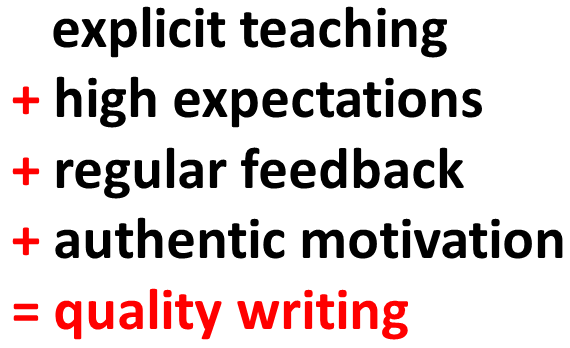
For some reason, I didn't think that it was necessary to explicitly teach the mechanics of blogging.  I discussed WHY we were blogging, but I never went into the details of HOW to blog.  Next year I will take time to discuss feedback and continuing conversations.  Additionally, as previously mentioned, I had a specific number of posts and responses I wanted the students to complete.  These expectations aren't high enough, nor do they reflect what I really want the students to get out of blogging, which is deep thinking about their learning.  By providing regular feedback, students will be reminded of the high expectations they are to be meeting.  Authentic motivation is so important, but I think can be difficult, especially when students aren't interested in the topic.  Unfortunately, some topics can't be helped...they are part of the curriculum.  I see it as my job to try and make topics relevant and help students to make a personal connection.

Additionally, I will share this blog post, by Doug Peterson (@dougpete), which details tips for successful blogging.  One of the points that stood out was the fact that blogging takes courage.  I will share with my students how difficult I, as a teacher, find it to post my thoughts.  As I was writing this post, I hesitated if I would even publish it.  I also liked the point about being positive.  When I started this post, I wondered if I was being negative, but then I thought some more about the purpose.  My  purpose was to explore the drawbacks I encountered and find ways to improve blogging.  Ultimately, I don't think I am complaining; rather, I like to think that I am being constructive.

I have quite a lot of work ahead of me to make blogging work for my classes and I am always looking for ways to improve the experience.  I truly believe that blogging can be powerful for students and teachers alike and I am not willing to give up.


Wednesday, 17 April 2013

Today was an A+ Day

If I graded every single day, I would give today an A+.

http://w4wn.com/
To begin, my Block A class (CHC2P1) was fantastic...but that is typical.  We were in the library working on our photo album of the Depression and World War II.  The majority of the students hopped right onto the computers and got to work.  I hardly had to poke or prod them to get right to it.  One student asked me to check his first photo and caption.  He asked, "I'm going to use the PPE* method for my captions.  Is that okay?"  I was taken aback...I haven't taught the students PPE and didn't really expect that much detail.  Naturally, I told him that was a great idea, plus it's a really great example of his ability to transfer his knowledge to new tasks.  Based on checking the other students' work, I think there are going to be some stellar examples of learning.


http://www.socrative.com/
My Block B class (CHC2D1) is rather challenging.  I am having a very difficult time engaging them.  It doesn't seem to matter what I do, nothing is interesting.  The object of today's lesson was to review conscription in World War I to frame our understanding of conscription during World War II.  Totally boring.  I wasn't sure how I was going to review the WWI conscription crisis, but I remembered that Lisa (@l_unger) has been playing around with socrative.com, a "clicker-esqe" type web program.  I created a conscription crisis review quiz using socrative.   Each student signed into the quiz using their phones, plus I brought in eight iPads for students who didn't have an Internet capable phone.  The quiz was a hit.  Students cheered when they got the right answer and groaned when they didn't.  Some asked if we could do this more often.  (Fortunately, I have already planned a similar activity for Friday when we do the Italian Campaign.)  I finally found something that interested them.  Now I need to find some more tools to try and keep their interest.

My Block C class (ENG3U1) is always awesome, even though they (for the most part) do not enjoy reading Macbeth.  This blows my mind, because I love the play.  In February, a couple of students were late because they were at Dairy Queen.  I joked that the least they could have done was bring me a Smartie Blizzard, my favourite.  Fast forward to today...a couple of students bring me a Smartie Bllizzard.  I'm impressed they remembered that it was my favourite.  They're automatically getting A's.  (Actually...they legitimately have earned A's...I'm not that easily bribed.)


http://indianapolisblogs.blogspot.ca/2012/08/color-me-rad-indianapolis-5k-run.html
The final reason why today is an A+ day is my running.  My friend Holly and I went for a great run and I always feel great after a run.  Many of the English Department members are running, so we are starting an informal English Department Running Group.  Our first run is this Friday.  I'm looking forward to it.  Lastly, I signed up for my first 5km run.  It is called "Color Me Rad" and takes place June 22.

I love A+ days!


*For the non-teacher kind, PPE stands for Point, Proof, Explanation, which is a method for students to structure their writing.

Saturday, 13 April 2013

Tweeting Macbeth

I went into the Macbeth unit knowing full well that students in general don't enjoy reading Shakespeare.  I remembered that Danika Barker, (@DanikaBarker), a teacher with Thames Valley DSB had her students tweet Hamlet.  You can read about her project  here.  After scouring Danika's online resources, I decided that I was going to try this out.

My ultimate reason for undertaking this project was to engage students in the play.  (Also, in a survey at the beginning of the semester, a student suggested tweeting Macbeth.)   It would be a familiar way for most students to engage in a language that is unfamiliar.

We are still working our way through the play, so these are just my preliminary thoughts.

I am finding "Tweet Mac" to be an informal way to gauge the students' understanding.  For example, one character tweeted that Macbeth shouldn't have killed Duncan, his father.  Clearly, that student is unclear about some of the basic facts of the play.  It is my job to now clarify this misunderstanding with the class.

I started out by opening up Twitter accounts for each of the characters in Macbeth.  Before I did this, I read over Twitter's terms and conditions and I couldn't find any clause disallowing the creation of "dummy" accounts, like Facebook has.  It is incredibly tedious to open 30 Twitter accounts.  I did this over the span of three weeks, as I could only do three or so in a row without going crazy.  I didn't want the students to open the accounts themselves, because I wanted to maintain control.  This way, I can also reuse the accounts when my future students learn Macbeth.

In preparation for "Tweet Mac", I asked students to bring their own Internet devices to class with them, if possible.  I also brought in iPads for the students who couldn't bring in a device.  I think we were successfully one-to-one that day.  Here is a copy of the task sheet:  Tweeting Macbeth.  (I realized that I forgot the Porter and the Old Man.)  Students spent the period playing around with Twitter and researching their assigned character.

Some students have really taken to "Tweet Mac" and tweet frequently and outside of school. As is expected, some haven't tweeted at all.  I have discovered that I need to set aside some time a couple of days a week (10 minutes at the end of class) dedicated to tweeting.  While it is disappointing that some students aren't participating, I'm not letting it get me down, because I think it is almost impossible to engage an entire class.

You can view this list to see the tweets. Or you can check out the Storify of the tweets thus far.  It is here, most recent tweet to oldest.

My next attempt to make Macbeth interesting is The Great Meme Challenge of 2013.  After a passage analysis summative, of course.


Student Thoughts on Studying Shakespeare

Many students (most?) are not fans of studying Shakespeare.  Some of my students wrote blog posts explaining their dislike.  For example, Branson argues that there are many modern texts that can be taught in the classroom that touch on the same messages that Shakespeare puts forth.  Additionally, Cassidy argues that it is too difficult, creating an unfair advantage for those who find it easy.

I was very surprised that some students put forth arguments supporting the importance of studying Shakespeare in high school.  Madison and Katie clearly outline the importance of studying Shakespeare.  For example, they believe that reading Shakespeare helps them to develop their thinking skills, as his complex writing forces them to really sit with the language.  In fact, Madison's post was able to convince Meghan of the importance of reading Shakespeare in high school.  Rachel's post starts off listing the reasons why students don't like studying him, but she ultimately defends his inclusion in the curriculum.

I'm glad that so many of my students decided to write blog posts about the study of Shakespeare.  In class, a student asked why we were reading Macbeth.  I was on the spot and all of my reasoning seemed lame.  Next time I am asked this question, I will have reasons DIRECTLY from students as to why the study of Shakespeare is important.


Tuesday, 26 March 2013

Initial Thoughts about Student Blogging

This semester I am embarking on blogging with two of my classes (Grade 10 Academic History and Grade 11 University Prep English).  My reasons for blogging are many:

  • Visible Thinking--a way to document the process of learning
  • Creation (not just consumption)--a way to create a personal understanding
  • Collaboration--a way to share and to challenge learning and ideas
  • Individualization--a way to make choices about learning
  • Authentic Audience--a way to have others see work, not just the teacher
  • Community Creation--a way to build a group to learn from
I find the students' blog posts easy and interesting to read and to respond to.  It was admittedly time-consuming to read the first blog posts and responses because I wasn't just responding to their ideas, I was also giving the students feedback on the quality of the posts and their responses.  Additionally, I like that the feedback to the students is visible.  It isn't feedback just to look at, then throw in the trash.  The feedback is always there, for the individual to see and for others to see.  It is important to note that the feedback is both positive and constructively critical.  I have also noticed that students have read my feedback and have used that feedback to guide their own work and to help others.

Upon first blogging, there was a concern with goofy behaviour.  For example, one student tagged every post with #swag, another posted about a "pimpin' cat", and one more with Stanley from The Office laughing.  The next day I had a chat with each class about how we were using the blog space.  Fortunately, there haven't been any other issues.  My other concern is that students won't blog outside of class time.  I have provided class time so far, but I think I am going to start requiring students use time outside of class.

Next year when I blog with my students I will give a hard copy of the instructions to get on the blog.  For some reason, I assumed that the students would be familiar enough with UG Cloud that they could maneuver it without step-by-step instructions.  I was wrong.  Additionally, I would provide more direct teaching about responding to blogs.  Students often respond with "Nice post!" or something equally as generic.  I want them to actually have a dialogue with each other to build upon each other's knowledge.  I have noticed, though, that the quality of the responses are improving, especially since I gave feedback to each student about their responses.

At first I wasn't sure how I was going to keep track of the students' posts and their responses.  I like things nice and orderly, so I have a rubric for each student in a duotang, alphabetized.  Every time I read a student's post, I note the date on the rubric and place check marks in the appropriate places on the rubric.  The feedback is given as a comment to the student's post.  At midterm and final, I will look at the rubric and determine the student's mark based on where most of the check marks have fallen.  For some, this might not be specific enough, but I don't think that assigning marks is an exact science and I don't see the difference between a 73 or a 74 or a 75.  I follow the same method to assess comments to other students' blogs.

Another tip, which was shared with me by Lisa Unger (@l_unger) was to have the students label or tag their posts.  This makes it easy to find the students' posts quickly.

And finally, have a blog post with a list of prompts or ideas for writing.  Sometimes the hardest part of blogging is having an idea.

Monday, 11 February 2013

Reflections on Teaching CHY4U1

I was very nervous about teaching The West and the World (CHY4U1).  There is a lot to know and I was moving away from the typical essay/document study/seminar format.  In case I teach the class again, I want to make note of the things that I think worked and the things that need to be improved upon or completely dismissed.

1.  For the 2013 school year, the Ministry of Education changed the course to "World History".  As a result, I think the big idea will need to change to better reflect the curriculum expectations.  I could be wrong and won't know until the new curriculum documents are released.

2.  I decided to stray from a chronological framework.  The main reason I decided to structure the course thematically is to allow students the opportunity to learn about what they were interested in.  I felt that a chronological structure (first we learn about the Enlightenment, then Romanticism, etc.) would limit the students' choice, because they would have to stick to a topic that was applicable to just the time period we were studying.  Additionally, in a course that covers 500 years, the more recent history often gets missed.  This happens in the grade 10 course and we're only dealing with 100 years of one nation's history!!

Because the course was structured thematically, I thought the students needed some chronological framework.  As a result, we completed a collaborative Google Document to get some basic background about the various time periods.  The document is here.  For some reason, I felt that the students needed to have a quiz.  Why?  My reason is admittedly lame...ensure that the students learned the material.  Obviously, a quiz of this nature doesn't really measure a student's learning.  In the future, I would encourage students to complete the task and use it as reference as needed.  My true goal was to have students create a framework to refer to, not to know the minute details.

3.  Right off the bat, we worked on defining the Western world.  I think this was an important task because it introduced the students to the various interpretations of what constitutes the Western world.  Depending on the curriculum changes, this may not be necessary.  If this definition is necessary, I would not have the students write an essay.  I think an analytical paragraph would suffice.  I had the students complete an essay because I knew that they wouldn't be writing a formal essay.  I was fearful of removing an essay completely from a grade 12 university preparation course.  Upon reflection, a short essay at the beginning doesn't really do anything of substance to prepare the students.  I would rather focus on the skills that an essay attempts to get at:  creating and defending an argument using appropriate evidence.  The essay assignment is here.

4.  Throughout the course, students completed three document analyses.  These were completed in class.  If I teach the course again, I would continue with the document analyses.  I think it is important for students to engage in primary sources because they encourage students to read materials closely, think critically and express themselves in a clear and concise manner.

5.  The first unit of study was Revolution.  This unit and the second unit about war were more traditional because the content was teacher-driven.  I chose to do this because I wanted to gradually give the students more control to self-direct their learning.  We focused on the French Revolution and the Industrial Revolution.  I wouldn't change the summative task, which was the creation of a pamphlet.  Students had complete freedom to choose a revolution of their choice to study.  Additionally, as a class, we created the parameters of the task.  The templates used to design the task were based on Ted McCain's book Teaching for Tomorrow.  The assignment is here. 

I didn't want the summative task to assess the content that the students learned about the French Revolution and the Industrial Revolution.   I am more interested in assessing the skills the students have developed.  These skills include the ability to complete research and synthesize that research into a well supported argument.  That doesn't mean that the content doesn't matter...the content has to be historically accurate and thorough to demonstrate the important skills.

6.  The next unit was War.  The unit followed a similar format to the previous one.  We did some work about World Wars One and Two and the summative task was to research the influence of a person from one of the wars.  This assignment is here.The students shared their thesis and supporting evidence in a presentation.  Unfortunately, the presentations were long and, oftentimes, boring.

I still think that the ability to present is important, so I wouldn't get rid of this assignment.  I would do more formative presentations to give the students feedback.  Additionally, I would do away with the requirement to include video and/or images.  Students didn't do a good enough job actually using the audio-visual to support the thesis.  I think that through the other assignments, students will get enough practice using images as support.  I will have the students focus on presenting their understandings using their language.  I don't want them to rely on audio-visual to do it for them.

7.  The next unit looked at science and technology.  This was the first time that I really jumped into Project Based Learning.  The links below are my reflections on the unit.
Trying Out PBL
Actually PBLing...If That's a Verb
Reflecting on Science and Technology PBL
Final Thoughts on Science and Technology PBL

8.  The final unit was Colonialism.  This unit was very rushed, because there was only eleven days to complete it, including the summative task, which is here.  Because it was so rushed, I am having trouble reflecting on what I would do differently.  Part of me think that I would only have three units and dedicate more time to those units and more skill development.  I don't know what unit I would delete.  While the colonialism unit was underdeveloped, I think that it could be a powerful and interesting unit.  I also think that there will be less time to complete a full four units, because I intend on incorporating a blogging component and that will easily take eleven class periods.

9.  As previously mentioned, I would have the students contribute to a blog throughout the course.  I think blogging is an excellent way for students to think about course material, share their ideas and collaborate with others.  This Google Presentation further explains the role of blogging.  (Ideas contributed to the presentation come from PLC with Alanna King and Lisa Unger.)

Blogging also allows reflection, which I attempted to have my students do after each assignment.  The debrief questions are here.  I found that the students didn't take the debriefs seriously.  I am hoping that by making their reflections visible (and not so formal), they will see that others shared similar problems and perhaps a conversation can take place between students about how they can improve their skills to improve their learning.

10.  I was very happy with the culminating task.  The task was the contribution of a blog post to a common blog about the future influence of the Western world.  The collaborative blog is here. Originally, the task wasn't in the form of a blog.  I didn't have a concrete idea as to how I wanted students to share their learning...I just knew what I wanted the students to demonstrate.  I took a risk with using a blog, despite the fact that most students had little to no experience with blogs.  I was impressed with students' ability to demonstrate their learning in this format.  I liked the blog because students had an authentic audience.  On exam day, students had to respond to two of their classmates' blogs.  We did some practice with responding during class and I was impressed by the level of thought students demonstrated on exam day.  I can only imagine how great the students' work can be if we blog throughout the semester.

Overall, I enjoyed learning with my students and think that the semester was a success, but I see where I need to make changes and improvements to aid in student learning for future semesters.

Monday, 14 January 2013

Getting Excited about Student Blogging

I only started blogging roughly five months ago.  I often have trouble writing my posts for a couple of reasons.  I have trouble finding the time to actually physically type my thoughts.  I do a lot of thinking, and while I am thinking I often compose a post in my mind, but it doesn't usually make it to the computer.  Secondly, I also wonder if anything I have to say is "smart" enough...so I take the chicken's way out and just don't publish anything.

Despite being new to blogging, I am quickly falling in love with it.  I see the value in sharing ideas and having discussion, asynchronously.  And I want my students to do it too.  I jumped in head first, without much pedagogical thought.  My grade 12 history class is composing a blog post for their culminating task and on exam day, they will respond to two of their classmates' posts.  (We have a common blog and everyone is a contributor.)  So far I love the assignment...but I should have been having the students blog and respond to others' blogs throughout the semester.  And I should have known better...my school does A LOT of work on backward design.  (I will forgive myself...this is my first time teaching the course and halfway through I decided I didn't like the culminating task and changed it.)

Today I had my students read and respond to blog posts from Lisa Unger's (@l_unger) grade ten history class.  Peter Skillen (@peterskillen) and Brenda Sherry (@brendasherry) provided me with some great resources for responding to blog posts and my students used these resources well, as evidenced by their responses.  You can access the resources here and here. I took time to read the grade ten posts and my students' responses.  I was wildly impressed.  My students' responses were often thought provoking by offering opposing viewpoints with evidence.  They also asked the grade ten students interesting questions to further their thinking.  Furthermore, I really liked that I could give my grade twelves feedback so easily by simply responding to their comments on the blog posts.

My foray into student blogging (thanks to Lisa's encouragement) will be continued next semester, as I plan on having two of my three classes blog throughout the semester.  Wish me luck!!